
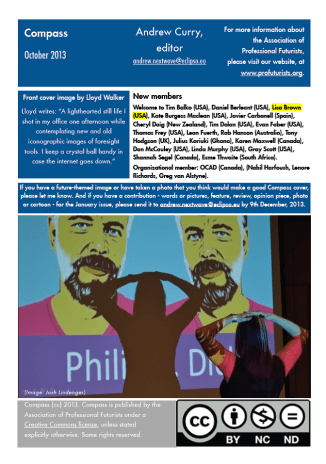
The October issue of Compass welcomes it’s new international membership. I was excited to see my name listed among the new inductees.
It was so wonderful seeing my name listed among the new international members, in the October Issue of Compass, the Association of Professional Futurists publication. This honor, plus the richness of my focus group data I obtained on Friday, and a positive email today indicating how my plans for travel to Santiago for data collection are going forward has me encouraged. Everything appears to be all coming together for the good. God is really blessing my life and giving me favor and vision. I’m so excited! 🙂 Moreover, I finally have post IRB approval DATA!! Now I can start submitting manuscripts based upon the research from my preliminary findings in addition to using the information for grant and scholarship applications, and let me tell you the prelims are rich!
My proposition for my focus group is that the graduate students studying in different educational contexts (public being one and private the other) would evidence very different descriptive differences relative to their civic engagement level as well as their Spiral Dynamic Theory memetic taxonomy here in Chile. The research position appears to be holding very strongly based upon the preliminary data. I am undertaking a Mixed Methods research agenda and am waiting with great anticipation to see how the graduate students represent, in relation to civic engagement and memes, with the quantitative data vis-á-vis the research collections from my Spanish translated survey measuring instrument.
RECOMMENDATION: Please Practice Tests your Protocols
Of course, as a newly “minted” ABD and doctoral candidate, I wanted to hit the ground running as my survey was based on preexisting instruments. However, my committee in their wisdom strongly encouraged me to test my protocols with a smaller sampling of participants before embarking upon the larger Santiago-based research. And boy where they right! This past Friday was my trial run of the protocols in order to, among other things, identify any possible problems in either my technology or research design. Only by doing my trial run (or pilot) was I able to find out that my videotaped focus group recording had a terrible background noise. I thought that my recording equipment was defective and immediately began to have nightmares of how I was every going to replace/repair my camera still under warranty with the disadvantage of currently residing in another country and likely needing to conduct this business in Spanish.
Thanks to my summer course EDIT 6150e Intro to Computers for Teaching, my immediate thought was to look to free troubleshoot advice via the internet. I decided to do a YouTube search regarding my “noise problem” and was able to locate some troubleshooting videos of my exact problem. I was relieved when I learned that the noise was likely due to the malleable cover I purchased designed to protect my Bloggie camera in the event of a fall. The silicon vest was every so slightly covering the three tiny microphones and producing a horrible background noise that distracted from the video record. So, I removed the camera from the protective sleeve, retested the sound quality and it worked magnificently.
Other recording issues arose with a new software I was testing for voice recording that came with the Bloggie recording device. Fortunately, I was familiar with the Audacity open-source audio capturing software so I was able to use that as my back-up and it worked great in large part because of the Yeti microphone. I purchased the Yeti before arriving to Chile as it has an option to record in a 360 degree circumference, ideal for focus group interviews. I also have a Zoom H1 hand held audio recorder that I plugged an external microphone into so as to check the sound quality compared to the Yeti mic. I learned that for face-to-face interviews were speakers are in close proximity to the microphone the Zoom H1 audio quality was good, but unlike the Yeti, it did not have the strength of capacity for record from long distances or in a type of surround-sound quality as did the Yeti microphone.
In conclusion fellow researchers, ABDs, and soon to be out in the field scholar, the lessons are:
1) Select an awesome dissertation committee and Chair from the outset.
2) Listen to your committee, and “go rogue” on a selective bases.
3) Test your protocols in advance of your primary data collection dates.
4) Don’t panic when you run into an unexpected bump in the road, relax, relate, release, and think!!
The last point above I believe is the most important, because we have spent the last few years of our academic journey learning how to think, think critically, and problem solve. No where better to test those skills than doing your field research and if you are blessed to be doing your research within an international context, I would count that as opportunity GOLDEN!! 🙂 Hope you found this blog post helpful.
Chau!
 The Chilean Chronicles Blog (The US Return Extended Version)