The Life of a foreign woman in Latin America – Things different and the same.
Are racism & misogyny losing ground?
Some of you might be aware of the recent scandal happening in the United States relative to NBA team owner Donald Sterling. For those unfamiliar with the event, he was audio recorded in a spat with his “girlfriend” (mistress) who also happens to be of a Mexican and Black racial identity background. Sterling was caught in a peppered stream of racists and misogynistic rants that would make most octogenarians’ shutter (Sterling is 8o+ years old). His visibly younger paramour, appears to have also had a sexual relationship with Sterling because in the audio tape (Google it if you want to hear it as I do not want to embed that messy link on my blog) he graciously extends to the woman an offer to sleep with other black men that she would fancy. The only caveat relative to his sexual invitation was that he forbade her to bring such black associates to his basketball games. Moreover, he admonished her to work harder at being a more delicate, desirable woman, and to use white women as her prototypes.
Turning the channel just a “skotch”, in my Twitter news feed on yesterday I saw that a Brazilian soccer player who is a member of Spain’s soccer team, suffered the indignity of a racist taunt. Someone threw a banana onto the playing field in proximity of the athlete, to suggest that he was a monkey, in an effort to insult him. His response was to pick up the banana take a bite of it, and go back to playing his game. Ha ha, kudos to him for keeping it classy!! Today, on my friend Fernando’s blog, The Talking Violin, I had a chance to better understand the story. That was because when I searched for an image of the player (Daniel Alves), who someone thought looked like either a monkey or of Black heritage, he appeared visibly to me as neither… But, what does that mean? What does “looking” Black mean such that it is internationally viewed as something to be feared or chided?
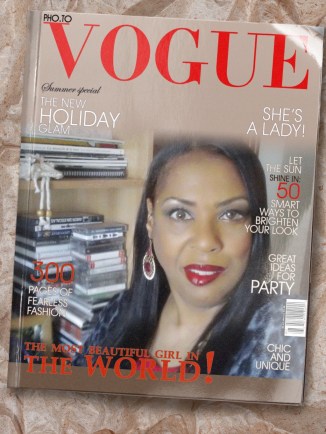
So last night, in my idle internet surfing time (which happens a lot as you try to complete your dissertation), I decided to create a fake magazine cover of myself with a Facebook photo I recently took (see above). What was most interesting to me (in my pseudo-scientific study) is how many people liked the picture and some indicating that I looked Latina. This is not the first time that someone thought I was Latina just from my picture. At first, I thought it was because I was studying in Chile and someone might have assumed I was of a Latin background. Some here in Chile have wondered if I were Columbian. In actuality, my father always told us about our Native background with his side of the family coming from Louisiana, Texas, and Oklahoma. Like most multicultural/multiracial groups you are defaulted to what is considered the lower sociopolitical group (at least historically in the case of the United States) if you have only a “hint” of non-white blood.
The irony is that things are changing in our World. Most anthropologist and social scientist who study race in the United States project that the “appearance” of a so called minority persons will continue to become quite ambiguous for distinction as either Black, White, or Other. So what will that mean for power and privilege dynamics in the future? Will Blacks be threatened to have their metaphorical “Black-pass” taken away from them if they do not boldly with raised fist proclaim to the world “I am Black!!” Will it also require the refusing to accept any privileges or opportunities that a non-black ambiguous appearance might be afforded? Some people may choose that route, but I think many will not because many people are not always consciously aware of how race, in some cases, has subliminally impacted their lives and how others perceive them based on phenotype expressions.
How many times has someone responded in a pleasant manner to you, in spite of your “blackness” or “whiteness” because you reminded them of a prototypical Black that they are comfortable with engaging (e.g., Oprah, Colin Powell, Barack Obama, Beyoncé, or Aunt Jemima). I was not being snide about that last character reference, because many people view the image of a smiling, robust, Black woman (especially cooking some pancakes) as safe and inviting.
But, here’s the good news, and where I introduce my dissertation theoretical framework of Spiral Dynamic Theory and Memetics. Below in a hierarchical framework introduced by Clare Graves, who found in his research that adults go through stages of developmental change moving from simplicity to higher order thinking and problem solving. Additionally, the framework oscillates between more individualist worldviews (right side) to more collectivist worldviews (left side) which are subsuming systems and remain a part of your cognitive toolkit as you advance through the spiral. Graves primarily developed the first 6 levels of the framework before his death in 1986. Myself, along with other scholars and practitioners’ of the Gravesian-Spiral Dynamics frameworks, are seeking to better define the higher order levels (of memetic worldviews in my case) in this diagram. I am specifically looking to expand on this theory and framework in my civic engagement research.
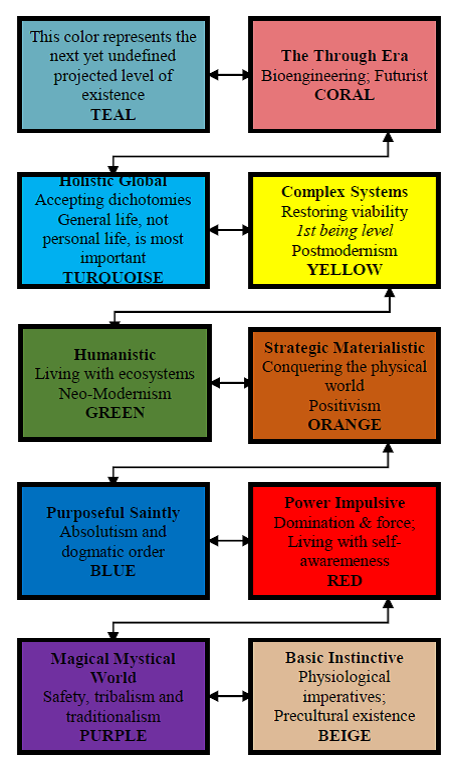
I am encouraged that the NBA decided to ban and fine monetarily Donald Sterling for his horrible remarks and actions, suggesting to me that perhaps we really could be making a higher order change on issues of race. The NBA sent a very strong message that the community (collectivist “we” worldview) of basketball would not find the actions of people like Sterling welcomed moving forward (Green vMEME). In the very short past, I would have expected more of a business decision were Mr. Sterling would have received maybe a public tongue lashing, possible fine, but still be allowed to retain his rights as owner and money maker in the league (Orange vMEME). I was pleasantly surprised by the NBA’s response yesterday to the incident.
Additionally, celebrities and fans of Brazilian athelete Daniel Alves took to social media with an outpouring of support towards him in the form of pictures of their eating bananas and metaphorically thumbing their nose at the racists. I also interpreted that as an Orange-to-Green memetic shift, because in the recent past, although some people might have thought the behavior shameful, they would not have been willing to risk their own social positioning in speaking out on a world stage in opposition to such negative and offensive racist behaviors. Bravo to them for shunning the, “I don’t want any trouble for myself” syndrome.
Nevertheless, it appears that in both of these instances, folks were willing to say I am not going to sit idly by and give this racist conduct a pass… Enough is enough, and we are looking to a better future and not to be shackled to an ignorant past. So to revisit the original question regarding misogyny and racism, I think the above two cited responses certainly signal positive horizons on issues of race, but women, and misogyny (as per usual) will likely be a little lower on the social re-engineering strategic agenda. But of course, I could be miscalculating. Let’s hope that is in fact the case. 🙂


 The Chilean Chronicles Blog (The US Return Extended Version)